


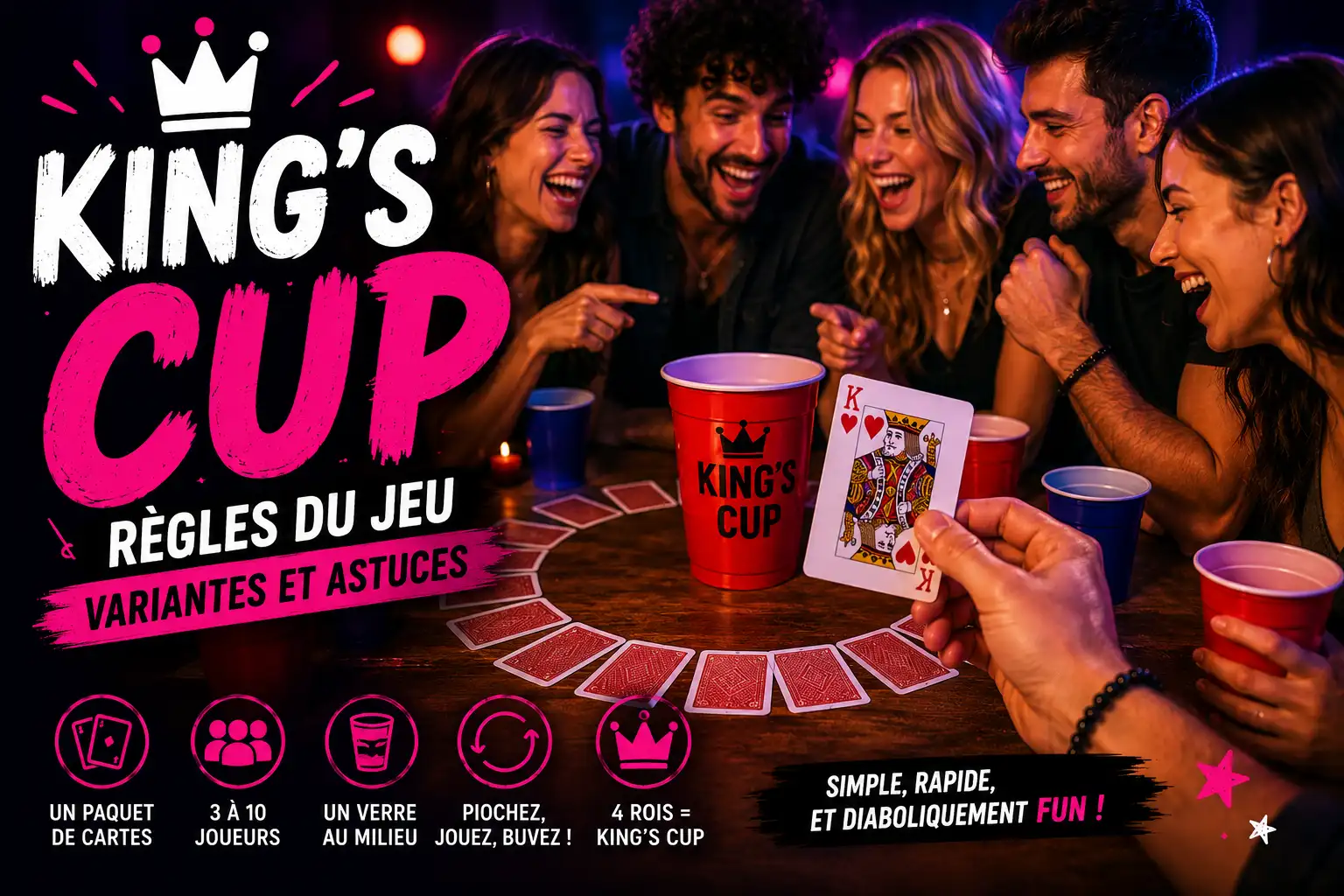
Are your evenings going in circles? You're looking for a game that's easy to explain, quick to start, but sly enough to create laughs and twists? The King's Cup ticks all the boxes. In this guide, I give you the rules of the game, punchy variants, and concrete tips to avoid long lulls... and the complicated mornings to come.
Equipment and setup (express setup)
The game boils down to a few things: a standard deck of cards, glasses, and a large container in the middle. Two minutes are enough to set everything up, and that’s precisely what makes King’s Cup irresistible as a pre-party or at the end of the evening.
- A deck of cards (52 cards, no jokers)
- A large central glass or a mug placed in the middle of the table
- A drink per player (with or without alcohol)
- A flat surface to lay out the cards in a circle around the glass
Arrange all the cards face down in a ring. Each player keeps their drink within reach. Before drawing the first card, agree on 2 points: the level of intensity (sip vs big sip, word bans, etc.) and the house rules you want to activate. This framing avoids debates in the middle of the game.
King’s Cup rules step by step (how it’s played)
The turn proceeds in the direction of your choice. On your turn, draw a card from the circle, announce it, and apply the associated effect. Most cards trigger an immediate action (drink, point to someone, rhyme). Others create lasting effects (ban, lifetime duo, temporary master).
Classically, when a King is drawn, pour into the middle glass. The person who draws the 4th King drinks the contents of the central glass. You can ease this rule (only a symbolic sip) or keep it for the final thrill. The game ends when all the cards have been drawn or when the last King has been drawn.
Card meanings (the most played version)
There are dozens of possible mappings. Below is the most common base, ideal to start off without mistakes.
| Card | Action | Pace tip |
|---|---|---|
| Ace | Cascade : everyone drinks at the same time, each person stops when the person to their left stops. | Start the cascade quickly to keep the table’s energy up. |
| 2 | “You” : designate someone who drinks. | Avoid targeting the same person multiple times in a row. |
| 3 | “Me” : you drink. | Announce a clear gulp (small, medium, large). |
| 4 | “Floor” : touch the floor; the last one drinks. | Count aloud for fairness. |
| 5 | “Guys” : all the guys drink. | Can be replaced by another inclusive category. |
| 6 | “Girls” : all the girls drink. | Same: adapt to your group. |
| 7 | “Heaven” : raise your hand; the last one drinks. | Surprise by raising it without warning during the round. |
| 8 | Partner : choose a person who will drink at the same time as you until the end. | Good way to balance the difficulty. |
| 9 | Rhyme : say a word, everyone adds a rhyme; the first to run out of rhymes drinks. | Favor everyday words for a brisk tempo. |
| 10 | Categories : name a category (cereals, capitals, consoles…). | Change meaning if it stalls. |
| Jack | New rule : invent a constraint (forbidden to say “drink”, mandatory accents…) | A funny rule > a punitive rule. |
| Queen | Master of Questions : anyone who answers you… drinks. | Play subtly, slip your questions into the discussion. |
| King | Pour into the central glass; the 4th King drinks it. | Decide the volume from the start (1–2 cm max recommended). |
Pro tip: set a ceiling dose in the central glass (two fingers maximum). The game stays fun, nobody gets hurt, and the tension around the last King stays intact.
Famous variants and twists that spice up the game
The King’s Cup lives on its flexibility. A few tweaks are enough to completely change the vibe: more of a party game, more strategic, or more “organized chaos”.
Ring of Fire : replace the central glass with an unopened can. Slip the cards under the ring of the tab. The person who makes the tab pop must open and drink the can. Nerve-wracking variant, perfect when you’re short on glasses.
Circle of Death : same principle as King’s Cup, but each card broken in the circle requires reconstituting the ring before continuing. Adds visual tension and a small dexterity challenge.
Thumb Master (Jack twist) : instead of a rule, the player becomes the Thumb Master; at any moment, he places his thumb on the table. The last to imitate drinks. Ultra-effective for surprising a distracted group.
You can also try: “Left hand only”, “No first names”, “Laughter forbidden” (immediate penalty), or a home-made Joker “Swap of Places” that redistributes energy around the table. The important thing is to announce your house rules before you start to avoid disputes.
Pro tips for a smooth King’s Cup (and really funny)
Start soft, increase the difficulty after one full round. This gives everyone time to grasp the mechanics and avoids eliminating a player too early because they pulled two “bad” cards.
Designate a “tempo master” who keeps an eye on the pace: remind players of turns, settle small disputes, restart a lingering Categories. A good rhythm = an engaged table.
Mix the sips: alternate water, soft drinks and mocktails. Not only does this make the game longer and more fun, but it’s also the basis of a responsible game.
If your group enjoys bluffing and decision-making, insert a mini-challenge in case of a tie (rock-paper-scissors, quick riddle). You keep the party-game spirit while adding a dash of strategy.
Playing with 2, 3, 6+ players: how to adapt without breaking the balance
With two players, King’s Cup can quickly become repetitive. Reduce the deck (remove the 2-3-4), switch the cascade to “drink together for 3 seconds,” and limit persistent cards (no more than one active New Rule).
With 3–4 players, keep the classic table, but cap symmetrical effects (like “Guys”, “Girls”) at “one sip for everyone” to avoid targeting the same person over and over.
With 6 or more, widen the playing area, set up 2 central glasses (small volumes) and double the “interaction” cards: two words for Rhyme, two themes for Categories. The chaos is more readable, and everyone participates.
Safe practices and consent
We have more fun when everyone feels respected. Remind people of the right to say no at any time, without justification. Always allow the option to “swap for a safe penalty” (sing a chorus, make a face) rather than forcing a sip.
Set a collective “stop word” that cancels the current action without debate. Provide water at the table, salty snacks, and a safe return (sam, ride-hailing, a place to sleep). The responsible game isn’t a constraint: it’s what extends the evening.
Alternatives and ideas to vary the fun
Want another drinking card game with an adversary-reading twist? You can check our guide on Fuck the Dealer (rules and step-by-step play), more tactical and perfect when the group wants to “play against the dealer.”
Into a “race and bets” vibe? Also try the PMU, a cult drinking game inspired by horse racing: easy to explain, suspense guaranteed until the final sprint.
Common mistakes to avoid (and how to fix them)
Overfilling the central glass at the start kills the fun: limit to two fingers, or replace with “one sip from everyone at the 4th King.” Forgetting to announce the persistent rules creates disputes: repeat them aloud as they come into play. Letting turns linger drags down the fun: if a player hesitates more than 5 seconds on a Categories, make them take a mini sip and move to the next.
The closing word
King’s Cup — also known as “Kings”, Circle of Death or Ring of Fire — shines with its simplicity and modularity. With a deck of cards and a few well-set rules, you have a game that bonds groups, triggers inside jokes, and adapts to the energy of the moment. Set the rules, dose the central glass, maintain the pace, and your table will have that perfect mix of chaos and control that makes for great evenings.
Friendly reminder: excessive drinking is dangerous to health; opt for modest sips, non-alcoholic variants, and safe returns. The goal isn’t to break a record, but to create memories that won’t fade.