


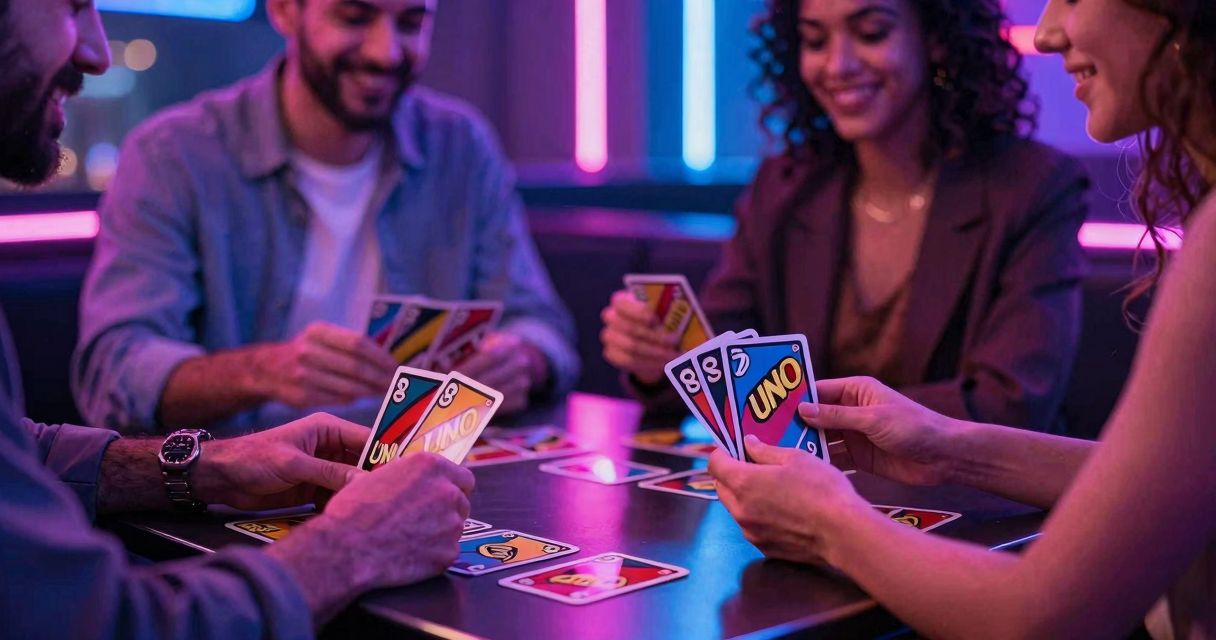
Are you looking for a game that sets the mood without needing 100 props or explaining the rules for 20 minutes? Drunk Uno turns a universal classic into a laugh machine, with a simple idea: every action triggers a drinking penalty. In this guide, I give you a clear framework, tips to avoid hassles, and variants that will ramp up the tension… at the right pace.
Drunk Uno: Principle, Spirit and Best Practices
Drunk Uno is not an official edition of the game; it’s a “party mode” built on house rules. That’s where it shines: you tailor the intensity and humor to the group. The heart of the system rests on a simple sentence to remind newcomers: every card played can have a social consequence (drink, distribute, cancel, react) in addition to its normal effect.
My hosting tip: set a friendly frame from the start. We play for fun, not to soak drinks at any price. Always plan non-alcoholic equivalents and alternative “bet/dares.” The only non‑negotiable rule: no one is forced to drink.
The common core to decide before starting: stacking allowed or not, penalty when you forget to say "UNO", default dosage of a sip, and the special status of the +4 (contest or not).
Materials and setup in 60 seconds
You need a standard UNO deck (108 cards), a table, and drinks (alcoholic or non-alcoholic). Shuffle, deal 7 cards per player, create a draw pile and turn the first card face-up on the discard pile. Choose who starts and in which direction we play.
- 1 standard UNO deck
- 3 to 8 players (4 to 6 is ideal)
- Something to drink… and water for hydration
Before the first card, confirm your settings: stacking allowed or forbidden, handling Jokers, UNO penalty and intensity level (sips vs shots).
Drunk Uno rules, card by card (clear and quick version)
You play normal UNO: match color or number, place a compatible action, draw if you can’t play. The below add the “party” consequences. To avoid arguments, keep this table handy.
| Card | Game effect | Who drinks? | Recommended dosage |
|---|---|---|---|
| Numbers (0–9) | Normal play (color/number) | The player who draws for lack of a playable card | 1 sip if you draw without playing |
| Skip | The next player skips their turn | The skipped player | 1 sip |
| Reverse | Reverse the order of play | The player “snapped” by the reversal | 1 sip |
| +2 | The next player draws 2 | The penalized player | 2 sips (accumulates with stacking) |
| Joker | Choose the color | The whole table | 1 collective sip (cheers) |
| +4 (Super Joker) | Chooses the color and penalizes 4 | The next player (table optional) | 4 sips for the target (1 for others if chosen) |
About stacking (a.k.a. stacking): if you allow it, a +2 only answers a +2, a +4 only a +4. The penalty stacks and lands on the first player who cannot follow. It’s explosive, but harder to track when drinks are flowing: clearly announce “+6”, “+8”, etc. to avoid confusion.
The challenge of the +4: you can allow a challenge if you think the player had another playable card of the requested color. If he lies, he takes the penalty. If he was right, the challenger takes it (and more heavily). It’s funny once, but it slows things down. My take: save it for comfortable groups; otherwise skip.
The UNO ! rule without shouting or drama
As soon as you have one card left, you must say "UNO" before the next player starts. If someone catches you in the act, you draw 4 cards and you drink as arranged by your house rules (usually several sips or a big penalty). If you accuse wrongly, it’s you who pays. Pro tip: allow “quiet UNO” if the vibe is loud; the idea is to be attentive, not to shout.
To keep the game flowing, I recommend a rotating referee: each round, a player nicknamed “UNO judge” decides in case of dispute and announces the standard penalties. It avoids endless debates.
Scoring, final penalties and end of round
The round ends when a player has no cards left. All others count what they keep in hand: numbers = 1 sip, actions (Skip, Reverse, +2) = 2, Jokers and +4 = 4. The heaviest hand may incur a small penalty (a shot, double portion, or distribution of sips). The winner, meanwhile, can offer a drink to anyone — ideal for teasing the table’s loudmouth.
If you chain rounds, shuffle the discard back into the draw pile when it runs out. And take a water break every 10–15 minutes: your fun will last longer, and your decisions too.
Variants that hit the mark (tested and approved)
Survival shots: each player starts with 3 small glasses in front of them. At any moment, you can drink one to “cancel” a penalty aimed at you (Skip, +2, +4, forgetting UNO, etc.). The glasses are single-use for the entire session: learn to pace yourself. Burning them too early makes you the table’s favorite prey.
Table slap: on every Joker (regular or +4), everyone taps the table. The last one takes a penalty (a shot or 2–3 hefty sips). The payoff is twofold: chaotic reflexes = guaranteed laughter, and every Joker becomes a little event.
Whisper round: after a Reverse, everyone must whisper until it returns to the player who triggered the reversal. Speaking normally = drinking. It’s surprising, because the adrenaline of a +4 often makes you forget the instruction.
Double attack: if you lay exactly the same card (same color and same number) as the one on top, the previous player drinks 1 sip. It rewards the lynx-eyed and punishes autopilot.
Hosting tips for a memorable game
Set the “drinking rhythm” at the start. For a long session, favor sips; reserve shots for big moments (big stacking chain, epic UNO forgetfulness…). Give yourselves also a semaphore word (“Water break!”) that anyone can invoke without justification.
Mix penalties: if some don’t drink, apply physical equivalents (push-ups, short planks), social (dares) or soft (juice, soda). The idea remains the same: immediate consequence, atmosphere that lives. Don’t forget hydration and some salty snacks: it stabilizes the evening.
If you like varying the rhythm, switch from a UNO game to a dexterity game: for example, see our Drunk Jenga guide to vary the sensations. And for a progressive tension build, you can also consult the rules of the drinking game Le Bus, perfect between rounds.
Concrete examples to avoid confusion
Case 1 — chain of +2: Alice plays a +2, Ben replies with +2, Chloe has nothing. Chloe draws 4 and drinks 4 sips. If you play “immediate play allowed,” she can still lay down the card she draws… but only if it matches the pile (color/number/action).
Case 2 — Joker followed by “cheers”: David plays a Joker, announces “Blue.” The whole table drinks 1 sip together. Élise must play a blue card, or a Joker, otherwise she draws (1 sip by default).
Case 3 — forget to say "UNO": Farid plays his penultimate card, forgets to announce. Gabrielle spots it before he plays. Farid draws 4, drinks the penalty as planned. If Gabrielle was mistaken (Farid had indeed said UNO), it was on her.
The closing word
Drunk Uno is proof that with a deck of cards and two clever adjustments, you can create an evening dynamic that doesn’t fade. Set your house rules in advance, choose an intensity level suited to the group, and let the cards write the story. One last friendly reminder: the best move isn’t always in the hand — it’s often the one that respects the table’s rhythm and keeps everyone in the game. Have fun, stay attentive, and may the next Joker make you raise your glasses... for good reasons.